Structure, notation, instrumentation and musical landmarks.
01 / WHERE IT STARTED
A recording is evidence of a performance, not a transparent copy of its written score. Translating it to useful notation raised a harder question: what part is composition, and what part belongs to the musician?
02 / WHAT GOT IN THE WAY
Pitch detection alone cannot tell us how music functions. Timing, phrasing, overlapping instruments, production, notation and performance choices can be mistaken for score facts.
03 / WHAT WE LEARNED
One celebrated recording cannot be the universal answer. Our Reference Lab framework compares three independently observed interpretations against a verified working score, preserving variation instead of averaging it away.
04 / WHAT WE BUILT
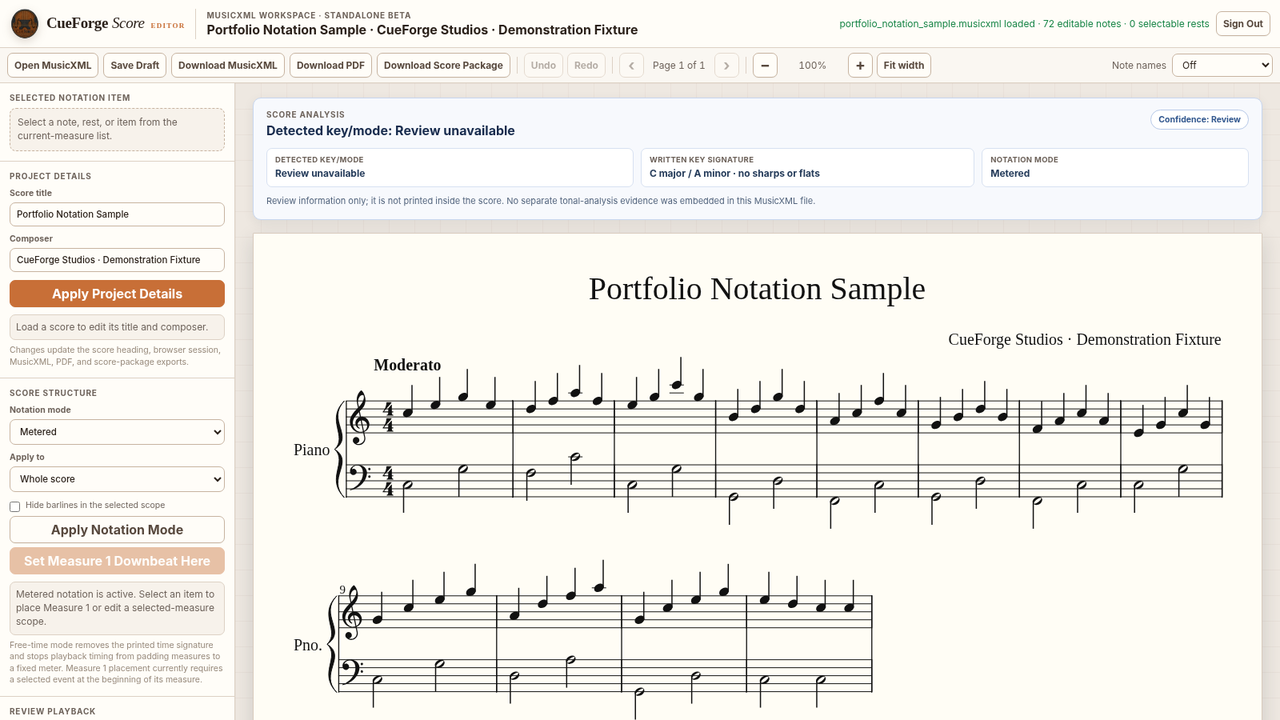
A deployed audio/stem processing path, MusicXML generation, review, notation editor, comparison and export workflow, plus a separate six-module Reference Lab with source/provenance controls and human-gated promotion.
05 / WHAT CHANGED
The processing pipeline was made operational. Benchmark tests, including Ode to Joy, demonstrated that an apparently successful export can still contain incorrect notes, duplicated parts, and truncated music.
06 / WHERE IT LED
This remains our substantial R&D case study. The product is operational, but transcription accuracy has not met the standard for release as an accurate one-click system.